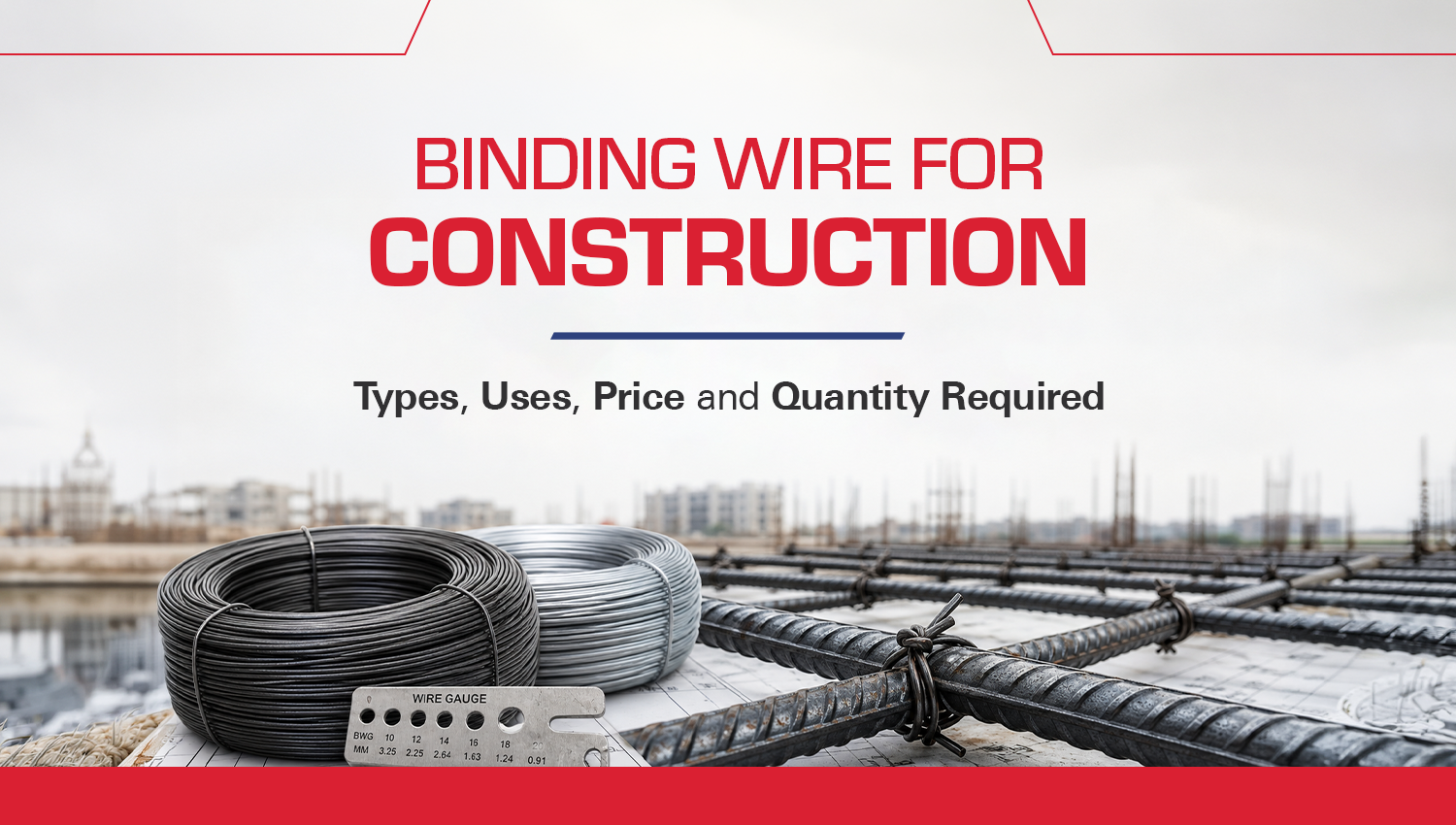
Binding Wire for Construction: Types, Uses, Price and Quantity Required
A strong reinforcement framework isn’t held together by TMT bars alone.
Before concrete is poured, reinforcement bars need to be correctly positioned, aligned, and securely tied. That’s where binding wire plays an important role.
It may be a small part of the overall construction material requirement, but the right binding wire can make a meaningful difference to tying efficiency, reinforcement stability, material wastage, and site execution.
At Bangur Steels, we believe every construction decision deserves the right information. That’s why this guide covers binding wire types, gauges, applications, quantity requirements, price factors, quality parameters, and what to look for before procurement.
Because knowing what you’re buying is the first step towards building with confidence.
What is Binding Wire?
Steel wire that is soft and flexible to use for tying the reinforcement bars together before pouring concrete is called binding wire. It is designed to secure the position of TMT bars as per the design, which will also stabilize the reinforcement cage during construction.
Binding wire is not designed to take structural loads, unlike reinforcement steel. Instead, it is used to keep the spacing and alignment of the steel bars and enable engineers to have accurate placement of the reinforcement according to the structural drawings.
In other words, binding wire doesn’t make the structure stronger by carrying load—it helps the reinforcement stay where the structural design requires it to be.
Binding wire is used in all reinforced concrete residential, commercial and industrial and infrastructure projects all over the world.
Why is Binding Wire Important in Construction?
A well-tied reinforcement cage contributes significantly to construction quality and execution Binding wire doesn’t carry the structural load of a building. Its role comes earlier—keeping reinforcement in the intended position before and during concreting.
A dependable binding wire can help:
- Secure reinforcement bars before concreting
- Maintain the intended spacing between bars
- Minimise movement during concrete placement
- Make tying work easier and more efficient
- Reduce breakage and avoidable material wastage
- Support accurate reinforcement execution
Small component. Important job.
The quality of the binding wire matters because inefficient tying can affect site productivity and reinforcement placement, even though the wire itself isn’t a load-bearing component.
This is more Bangur because we’re clarifying a misconception, not just selling quality.
Common Uses of Binding Wire
Binding wire is used throughout RCC construction wherever reinforcement bars need to be tied together.
Its most common applications include:
- Reinforcement cages for foundations
- Column reinforcement
- Beam reinforcement
- Slab reinforcement
- Staircase reinforcement
- Footings and pile caps
- Retaining walls
- Bridge construction
- Industrial structures
- Precast concrete components
It is also used in fabrication work, fencing, packaging, and various industrial tying applications.
Types of Binding Wire
Not every binding wire is suited to every construction environment.
The right choice depends on where the wire will be used, the level of moisture or exposure, the required flexibility, and the ease of tying needed on site.
Broadly, binding wires used across construction applications include:
Then continue with:
MS Binding Wire
GI Binding Wire
Annealed Binding Wire
MS Binding Wire
MS (Mild Steel) Binding Wire is one of the most commonly used wires in general construction.
It offers:
- Good flexibility
- Easy twisting
- Smooth tying performance
- Cost-effective application
MS binding wire is widely preferred for residential and commercial RCC construction where exposure to moisture is limited.
GI Binding Wire
GI (Galvanized Iron) Binding Wire features a protective zinc coating that improves corrosion resistance.
Compared to standard mild steel wire, GI binding wire offers:
- Better rust resistance
- Improved weather durability
- Longer service life
- Enhanced outdoor performance
GI binding wire is commonly used in coastal regions, humid environments, infrastructure projects, fencing, and outdoor construction applications.
Annealed Binding Wire
Annealed wire undergoes a controlled heat treatment process that increases flexibility and softness.
The annealing process makes the wire easier to bend and twist without breaking, improving productivity during reinforcement work.
Benefits include:
- Excellent flexibility
- Easy knotting
- Reduced breakage
- Improved workability
- Lower material wastage
Because of its ease of handling, annealed wire is one of the most preferred choices for reinforcement tying in RCC construction.
MS vs GI Binding Wire
The better choice isn’t necessarily the more expensive one. It is the one that matches the project’s environment and application.
|
Feature |
MS Binding Wire |
GI Binding Wire |
|
Material |
Mild Steel |
Galvanized Steel |
|
Corrosion Resistance |
Moderate |
High |
|
Outdoor Applications |
Limited |
Excellent |
|
Moisture Resistance |
Standard |
Superior |
|
Cost |
More economical |
Slightly higher |
|
Best Used For |
Residential RCC work |
Coastal & outdoor construction |
For general RCC work, MS binding wire may be suitable where exposure is limited. Where moisture, humidity, or outdoor exposure is a concern, GI wire may offer an advantage because of its protective zinc coating.
The right wire is the one that fits the job, not simply the one with the longest feature list.
Binding Wire Gauge Options
Binding wire is available in different gauges depending on tying requirements.
Common gauge options include:
- 18 Gauge
- 20 Gauge
- 22 Gauge
- 24 Gauge
Selecting the appropriate gauge depends on:
- Diameter of TMT bars
- Reinforcement density
- Construction application
- Ease of tying
- Site handling requirements
The right gauge helps improve tying efficiency while reducing unnecessary material consumption.
How Much Binding Wire is Required?
The quantity of binding wire depends on:
- Total reinforcement steel
- Bar spacing
- Structural complexity
- Number of intersections
- Reinforcement density
As a general thumb rule:
Binding wire consumption is approximately 0.8% to 1.5% of the total steel quantity.
Example
If a project uses:
4,000 kg of TMT bars
Binding wire required:
Approximately 32–60 kg
The exact quantity varies according to structural design and reinforcement detailing.
Binding Wire Price
There is no single fixed quantity of binding wire for every project.
Consumption depends on the total reinforcement quantity, number of intersections, bar spacing, reinforcement density, and structural detailing.
A commonly used thumb rule is:
Binding wire consumption ≈ 0.8%–1.5% of total reinforcement steel quantity
Example
If a project uses:
4,000 kg of TMT bars
Estimated binding wire requirement:
Approximately 32–60 kg
This is an indicative estimate, not a project-specific requirement. The actual quantity will depend on the reinforcement detailing and execution requirements.
Bangur Perspective
Use a thumb rule to plan. Use project details to decide.
What Affects Binding Wire Quality?
Not all binding wire offers the same performance.
Several manufacturing factors determine its quality, including:
Consistent Gauge
Uniform diameter helps ensure consistent tying performance while reducing wastage.
Flexibility
A high-quality binding wire should bend easily without cracking or snapping during tying.
Tensile Strength
The wire should be strong enough to hold reinforcement securely while remaining easy to twist.
Smooth Surface Finish
A clean and smooth finish improves handling while reducing injuries during site operations.
Corrosion Resistance
Rust-resistant wire performs better during storage and on construction sites exposed to moisture.
Uniform Coil Quality
Well-manufactured coils improve handling, reduce tangling, and support faster construction work.
What to Look for in Binding Wire Quality
Before choosing a binding wire, don’t look at price alone. Check:
1. Gauge Consistency
Is the diameter consistent throughout the coil?
2. Flexibility
Can it be bent and twisted without frequent breakage?
3. Grip
Does it hold the reinforcement securely after tying?
4. Surface Finish
Is the wire smooth and easy to handle?
5. Corrosion Resistance
Is it suitable for the environment where it will be stored and used?
6. Manufacturing Consistency
Does the manufacturer offer reliable quality from batch to batch?
A better buying decision starts with knowing what to check.
Products such as Bangur SmartBond Wire & Nails are designed with consistent gauge, dependable tying performance, and improved resistance to surface corrosion, helping construction professionals maintain reinforcement stability while improving on-site productivity.
Why Binding Wire Matters with TMT Bars
TMT bars provide the reinforcement required by the structural design. Binding wire has a different but important role: it helps hold those bars in their specified position before and during concreting.
Together, they form part of the reinforcement assembly process.
For accurate execution, it is important to consider:
- Correct TMT bar diameter and placement
- Required spacing
- Proper tying
- Stable reinforcement cages
- Quality of both reinforcement and tying materials
The TMT bar carries the structural load. The binding wire helps keep the reinforcement where it needs to be.
That’s a much stronger educational statement than simply saying “buy Bangur with Bangur.”
Why Choose Bangur SmartBond Wire & Nails?
Once you know what to look for in a binding wire, the choice becomes clearer.
Bangur SmartBond Wire & Nails are designed with a focus on the qualities that matter during construction:
- Consistent wire gauge
- Easy tying performance
- Good flexibility
- Reliable grip
- Improved resistance to surface corrosion
- Smooth handling
Designed to complement reinforcement work, SmartBond helps construction professionals maintain secure tying, efficient site execution, and consistent performance.
Because choosing the right binding wire shouldn’t be a guess.
It should be an informed decision.
Tips for Choosing the Right Binding Wire
Before purchasing binding wire, consider these practical recommendations:
- Select the appropriate gauge for your project.
- Choose corrosion-resistant wire for outdoor environments.
- Verify flexibility before procurement.
- Inspect the surface finish and coil quality.
- Purchase from trusted manufacturers with consistent quality standards.
- Match the binding wire with certified TMT bars for reliable reinforcement performance.
These simple checks can significantly improve construction quality while reducing delays and material wastage.
Conclusion
Binding wire may be a small part of a construction project, but its role in reinforcement stability, tying efficiency, and accurate execution makes it important to choose it carefully.
Understanding the different types of binding wire, knowing how gauge and flexibility affect performance, estimating the quantity required, and evaluating quality before procurement can help you make a better construction decision.
At Bangur Steels, we believe construction doesn’t become smarter simply by using better products.
It becomes smarter when people have the right knowledge to choose them.
That’s why our approach goes beyond manufacturing from Bangur Prime TMT Bars to Bangur SmartBond Wire & Nails, we aim to provide dependable construction solutions backed by the information needed to use them wisely.
Know better. Choose better. Build stronger.
Frequently Asked Questions
What is binding wire used for?
Binding wire is used to securely tie reinforcement bars together before concrete is poured, ensuring proper spacing and structural alignment.
Which is better: MS or GI binding wire?
MS binding wire is suitable for general construction, while GI binding wire offers better corrosion resistance for outdoor and moisture-prone environments.
How much binding wire is required for construction?
Typically, binding wire consumption ranges between 0.8% and 1.5% of the total steel reinforcement weight, depending on structural design.
What affects binding wire price?
Binding wire prices depend on steel market rates, wire gauge, manufacturing quality, galvanization, raw material costs, and order quantity.
What should I check before buying binding wire?
Look for consistent gauge, flexibility, smooth finish, rust resistance, strong grip, and reliable manufacturing quality to ensure dependable construction performance.
Download Catalog
Ready to build with strength you can trust? Connect with Bangur Steels and experience a partnership built on truth, innovation, and reliability. Whether you’re an architect, engineer, or builder — our team is here to guide you with the right steel, the right knowledge, and the right support to shape your next project with confidence.

Step into a world where steel carries more than strength, it carries trust and insight. Bangur Steel empowers every hand, every mind and every structure it touches. Together, we build safer, smarter and enduring spaces for generations to come.
-
Our Menu
-
Home
-
About Us
-
Products
-
Blogs
-
Quality & R&D
-
Contact Us
-
Connect with us
-
Office Address - 403, Ozone Centre, 4th floor, Ashok Nagar, Dhanbad-826001, Jharkhand
-
Mail Us
contactus@bangursteels.com -
Call Us
+91 9525151513
