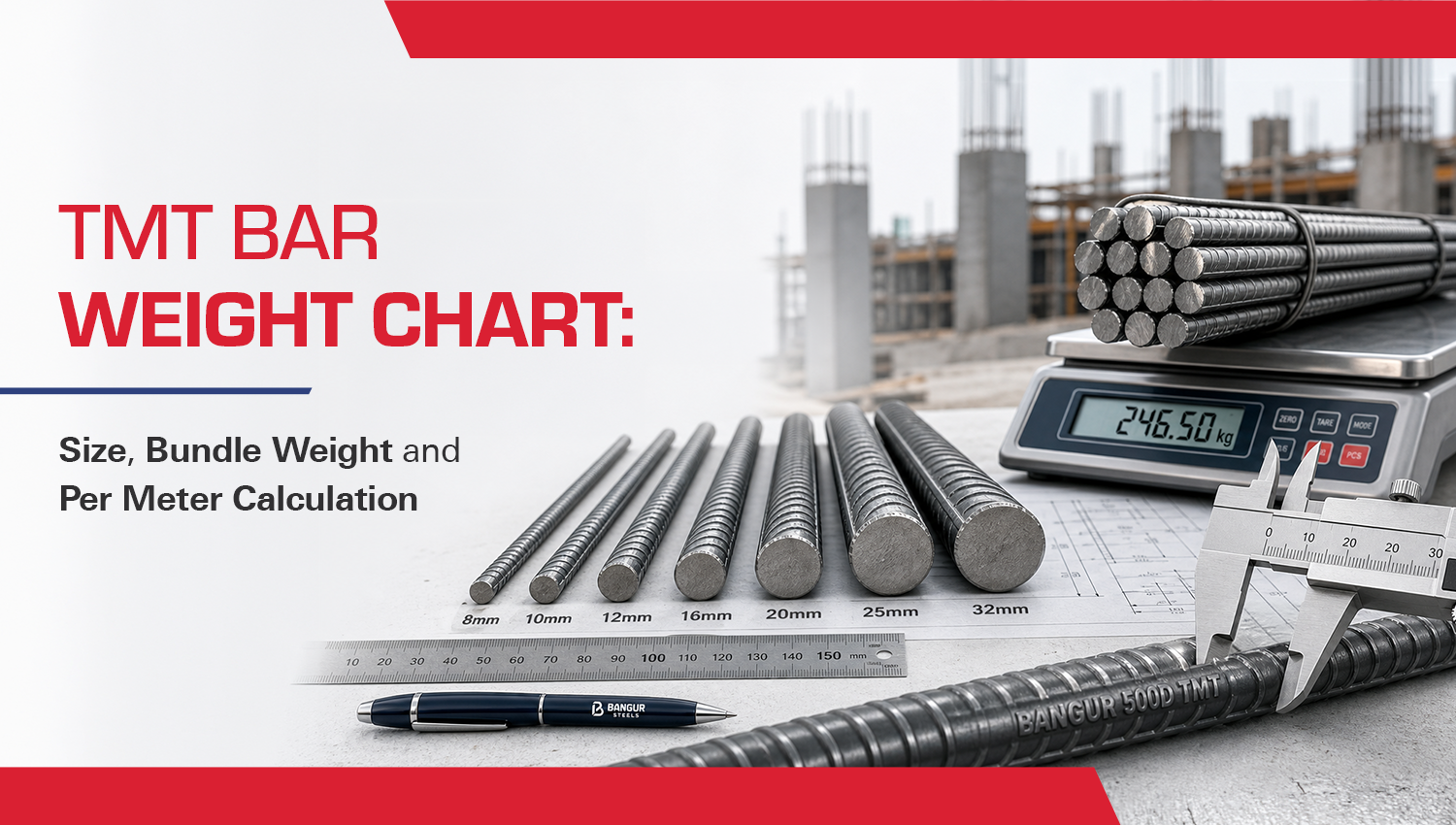
TMT Bar Weight Chart: Size, Bundle Weight and Per Meter Calculation
How much does a TMT bar weigh? And why does that number matter?
For engineers, contractors, builders, and project owners, TMT bar weight is more than a calculation. It directly affects steel estimation, procurement, project costing, transportation, and material planning.
Knowing the approximate weight of each bar size also helps you cross-check quantities and make more informed decisions when purchasing reinforcement steel.
At Bangur Steels, we believe better construction begins with better information. That’s why this guide breaks down TMT bar weight per metre, 12-metre bar weight, bundle weight, weight per tonne, and the standard formula used to calculate it.
Whether you’re estimating steel for a home, commercial building, or larger project, the objective is simple:
Know your steel. Plan better. Build with confidence.
Why is TMT Bar Weight Important?
TMT bar weight plays an important role long before the steel reaches the construction site.
It helps you:
- Estimate the quantity of reinforcement required
- Calculate approximate material costs
- Plan transportation and handling
- Manage inventory and procurement
- Cross-check supplied quantities
- Reduce avoidable material wastage
For large projects, even a small difference in estimated steel quantity can have a significant impact on overall material planning and cost.
That’s why understanding bar diameter, weight per metre, total length, and supplied quantity is an important part of making an informed steel purchase.
At Bangur Steels, our approach goes beyond supplying steel. We believe builders, engineers, contractors, and buyers should have the information they need to make the right construction decisions.
Standard TMT Bar Weight Chart
TMT bar weight varies with diameter. The larger the diameter, the greater the weight per metre.
The table below provides the theoretical weight per metre for commonly used TMT bar sizes, calculated using the standard formula:
Weight (kg/m) = D² ÷ 162
|
TMT Bar Size |
Weight Per Meter |
|
8 mm |
0.395 kg/m |
|
10 mm |
0.617 kg/m |
|
12 mm |
0.888 kg/m |
|
16 mm |
1.580 kg/m |
|
20 mm |
2.470 kg/m |
|
25 mm |
3.850 kg/m |
|
32 mm |
6.320 kg/m |
These are theoretical weights based on nominal diameter. Actual supplied weight can vary within the applicable dimensional and mass tolerances.
That little clarification makes the article feel much more authoritative.
TMT Bar Weight Per Meter Formula
The standard formula for calculating the TMT bar weight per meter is:
Weight (kg/m) = D² ÷ 162
Where:
- D = Diameter of the TMT bar (in mm)
Example
For a 12 mm TMT bar:
12 × 12 ÷ 162
= 144 ÷ 162
= 0.888 kg/m
This formula is widely used by engineers and construction professionals for estimating reinforcement requirements.
TMT Bar Weight by Size
8 mm TMT Bar Weight
- Weight per meter: 0.395 kg
- Standard length (12 m): 4.74 kg
Common Uses
- Slabs
- Staircases
- Small residential construction
- Secondary reinforcement
10 mm TMT Bar Weight
- Weight per meter: 0.617 kg
- Weight per 12 m bar: 7.40 kg
Common Uses
- Residential beams
- Columns
- Slabs
- Lintels
12 mm TMT Bar Weight
- Weight per meter: 0.888 kg
- Weight per 12 m piece: 10.66 kg
The 12 mm TMT bar is one of the most commonly used reinforcement bars in residential and commercial construction because it offers an excellent balance of strength and flexibility.
Common Uses
- Beams
- Columns
- Residential foundations
- Commercial structures
16 mm TMT Bar Weight
- Weight per meter: 1.58 kg
- Weight per 12 m piece: 18.96 kg
Common Uses
- Heavy foundations
- Multi-storey buildings
- Commercial projects
- Industrial construction
20 mm TMT Bar Weight
- Weight per meter: 2.47 kg
- Weight per 12 m piece: 29.64 kg
Common Uses
- High-rise buildings
- Bridges
- Large industrial structures
25 mm TMT Bar Weight
- Weight per meter: 3.85 kg
- Weight per 12 m piece: 46.20 kg
Common Uses
- Heavy industrial projects
- Flyovers
- Infrastructure development
32 mm TMT Bar Weight
- Weight per meter: 6.32 kg
- Weight per 12 m piece: 75.84 kg
Common Uses
- Dams
- Metro projects
- Airports
- Large infrastructure projects
- Heavy engineering structures
TMT Bar Bundle Weight Chart
Since TMT bars are generally supplied in bundles, understanding TMT bar bundle weight helps simplify procurement and logistics.
|
TMT Bar Size |
Approx. Bars per Bundle |
Approx. Bundle Weight |
|
8 mm |
10–12 |
Varies by manufacturer |
|
10 mm |
7–10 |
Varies by manufacturer |
|
12 mm |
5–7 |
Varies by manufacturer |
|
16 mm |
3–5 |
Varies by manufacturer |
|
20 mm |
2–3 |
Varies by manufacturer |
|
25 mm |
1–2 |
Varies by manufacturer |
|
32 mm |
1 |
Varies by manufacturer |
Note: Bundle weight may vary depending on the manufacturer, bar length, and packaging practices. Always verify the supplied weight before procurement.
How Many Bars Are There in 1 Ton?
Many buyers ask how many bars are available in one metric ton.
The answer depends on the diameter of the TMT bar.
|
Size |
Approx. Bars in 1 Ton (12 m length) |
|
8 mm |
211 bars |
|
10 mm |
135 bars |
|
12 mm |
93 bars |
|
16 mm |
52 bars |
|
20 mm |
34 bars |
|
25 mm |
21 bars |
|
32 mm |
13 bars |
These values are approximate and may vary slightly depending on dimensional tolerances.
Choosing the Right TMT Bar Size
There is no single TMT bar size that is right for every project.
The required diameter depends on factors such as structural design, load requirements, member dimensions, reinforcement detailing, spacing, and project specifications.
The final selection should always be based on the structural design and the recommendations of a qualified structural engineer.
That said, different TMT bar diameters are commonly used across different types of reinforcement work:
8 mm: Often used for lighter reinforcement and secondary reinforcement applications.
10 mm: Commonly used in residential RCC work and secondary structural applications.
12 mm: Widely used across residential and commercial RCC applications.
16 mm: Used where larger reinforcement capacity is required, depending on structural design.
20 mm and above: Commonly seen in heavier structural and infrastructure applications.
Don’t choose a TMT bar size simply because it is commonly used. Choose it because the structural design requires it.
Why Weight Consistency Matters
A TMT bar’s theoretical weight can be calculated using a simple formula. But when steel is purchased in large quantities, consistency matters just as much as the calculation itself.
Consistent dimensions and controlled manufacturing help make material estimation, procurement, and quantity verification more reliable.
For buyers and project teams, this can mean:
- More predictable material estimation
- Better procurement planning
- Easier quantity verification
- Greater consistency across batches
- Better control over material usage
At Bangur Steels, quality isn’t limited to the finished appearance of a TMT bar. Manufacturing consistency is an important part of delivering dependable reinforcement steel.
Because when you’re building with tonnes of steel, precision isn’t a small detail. It affects the entire calculation.
Calculate TMT Bar Weight Instantly with Bangur Steel Calculator
Calculating TMT bar weight manually is simple when you’re working with one bar. But when you’re estimating steel for an entire project, multiple diameters and quantities can make the calculation time-consuming.
That’s where the Bangur Steel Calculator can help.
Use it to quickly estimate:
- TMT bar weight
- Steel quantity
- Material requirements
- Approximate project requirements
Instead of repeatedly calculating diameter, length, and quantity manually, you can use the calculator to simplify your estimation process.
Less guesswork. More clarity. Better planning.
Use the Bangur Steel Calculator to make your steel estimation easier.
Why Choose Bangur Prime TMT Bars?
At Bangur Steels, precision goes beyond manufacturing—it extends to every bar that reaches your project site.
Bangur Prime TMT Bars are engineered using advanced manufacturing technologies, including PureBond Technology and DuraFlex Engineering, ensuring superior consistency, strength, durability, and structural reliability. Manufactured through precision-driven rolling mills and stringent quality control processes, every bar is designed to meet demanding construction requirements while adhering to ISI and BIS standards.
Whether you’re constructing a home, commercial complex, industrial facility, or large-scale infrastructure project, Bangur Prime TMT Bars provide dependable reinforcement backed by engineering excellence.
Conclusion
A reliable TMT bar weight chart plays an important role in construction planning, helping engineers, contractors, and builders estimate steel requirements with greater accuracy. Understanding TMT bar weight per meter, TMT bar bundle weight, and the appropriate size for different applications contributes to better material management, reduced wastage, and improved project efficiency.
At Bangur Steels, we combine precision manufacturing with dependable quality to deliver reinforcement solutions you can trust. For even greater accuracy, use the Bangur Steel Calculator to simplify your material estimation and ensure every project is built on a strong foundation.
Frequently Asked Questions
What is the formula for TMT bar weight per meter?
The standard formula is:
Weight (kg/m) = Diameter² ÷ 162
What is the weight of a 12 mm TMT bar?
A 12 mm TMT bar weighs approximately 0.888 kg per meter, and a standard 12-meter bar weighs around 10.66 kg.
Does TMT bar bundle weight remain the same for every manufacturer?
No. Bundle weight may vary depending on the manufacturer, packaging method, and supplied quantity. Always verify the actual bundle weight before procurement.
Why is TMT bar weight important?
It helps estimate steel consumption, project cost, transportation requirements, inventory planning, and structural calculations accurately.
How can I calculate TMT bar weight quickly?
You can use the Bangur Steel Calculator to calculate TMT bar weight, estimate steel requirements, and plan your construction materials more efficiently.
Download Catalog
Ready to build with strength you can trust? Connect with Bangur Steels and experience a partnership built on truth, innovation, and reliability. Whether you’re an architect, engineer, or builder — our team is here to guide you with the right steel, the right knowledge, and the right support to shape your next project with confidence.

Step into a world where steel carries more than strength, it carries trust and insight. Bangur Steel empowers every hand, every mind and every structure it touches. Together, we build safer, smarter and enduring spaces for generations to come.
-
Our Menu
-
Home
-
About Us
-
Products
-
Blogs
-
Quality & R&D
-
Contact Us
-
Connect with us
-
Office Address - 403, Ozone Centre, 4th floor, Ashok Nagar, Dhanbad-826001, Jharkhand
-
Mail Us
contactus@bangursteels.com -
Call Us
+91 9525151513
